North Korea Increases Aid to Russia, Mos... Tue Nov 19, 2024 12:29 | Marko Marjanovi? North Korea Increases Aid to Russia, Mos... Tue Nov 19, 2024 12:29 | Marko Marjanovi?
Trump Assembles a War Cabinet Sat Nov 16, 2024 10:29 | Marko Marjanovi?
Slavgrinder Ramps Up Into Overdrive Tue Nov 12, 2024 10:29 | Marko Marjanovi?
?Existential? Culling to Continue on Com... Mon Nov 11, 2024 10:28 | Marko Marjanovi?
US to Deploy Military Contractors to Ukr... Sun Nov 10, 2024 02:37 | Field Empty Anti-Empire >>
Indymedia Ireland is a volunteer-run non-commercial open publishing website for local and international news, opinion & analysis, press releases and events. Its main objective is to enable the public to participate in reporting and analysis of the news and other important events and aspects of our daily lives and thereby give a voice to people.
Trump hosts former head of Syrian Al-Qaeda Al-Jolani to the White House Tue Nov 11, 2025 22:01 | imc
Rip The Chicken Tree - 1800s - 2025 Tue Nov 04, 2025 03:40 | Mark
Study of 1.7 Million Children: Heart Damage Only Found in Covid-Vaxxed Kids Sat Nov 01, 2025 00:44 | imc
The Golden Haro Fri Oct 31, 2025 12:39 | Paul Ryan
Top Scientists Confirm Covid Shots Cause Heart Attacks in Children Sun Oct 05, 2025 21:31 | imc Human Rights in Ireland >>
Greens Plan to Punish Men Who Correct Women Sat Dec 13, 2025 17:38 | Will Jones
Men who correct women could face disciplinary action under plans being considered by the Green Party.
The post Greens Plan to Punish Men Who Correct Women appeared first on The Daily Sceptic.
Netflix Condemned for Gary Lineker Deal After BBC Antisemitism Scandal Sat Dec 13, 2025 15:00 | Will Jones
Netflix stands accused of "rewarding hateful rhetoric" by signing Gary Lineker in a lucrative deal after?he quit the BBC?over an antisemitic post he shared about Zionism with an image of a rat.
The post Netflix Condemned for Gary Lineker Deal After BBC Antisemitism Scandal appeared first on The Daily Sceptic.
Wes Streeting Says He?s ?Not Comfortable? With Puberty Blockers Trial and Claims Trans Activists Hav... Sat Dec 13, 2025 13:00 | Will Jones
Wes Streeting?has said he is "not comfortable" with a clinical trial into puberty blockers as he claimed "threatening" trans activists have attacked his constituency office on three occasions.
The post Wes Streeting Says He’s “Not Comfortable” With Puberty Blockers Trial and Claims Trans Activists Have Attacked His Office Three Times appeared first on The Daily Sceptic.
Miliband Isolated as EU Prepares to Reverse Petrol Car Ban Sat Dec 13, 2025 11:00 | Will Jones
Ed Miliband has been left isolated over his Net Zero policies after the European Union dropped "indefinitely" a flagship pledge to ban sales of new petrol cars.
The post Miliband Isolated as EU Prepares to Reverse Petrol Car Ban appeared first on The Daily Sceptic.
The Rest is Populism Sat Dec 13, 2025 09:00 | James Alexander
Brexit was a disaster, the climate is in crisis, populism is bad ? The Rest is Politics's Alastair Campbell and Rory Stewart agree on all the big centrist issues. And they're utterly wrong, says Prof James Alexander.
The post The Rest is Populism appeared first on The Daily Sceptic. Lockdown Skeptics >>
Voltaire, international edition
Will intergovernmental institutions withstand the end of the "American Empire"?,... Sat Apr 05, 2025 07:15 | en
Voltaire, International Newsletter N?127 Sat Apr 05, 2025 06:38 | en
Disintegration of Western democracy begins in France Sat Apr 05, 2025 06:00 | en
Voltaire, International Newsletter N?126 Fri Mar 28, 2025 11:39 | en
The International Conference on Combating Anti-Semitism by Amichai Chikli and Na... Fri Mar 28, 2025 11:31 | en Voltaire Network >>
|
Egypt and Colombia - lessons for the social movement
 international |
rights, freedoms and repression |
opinion/analysis international |
rights, freedoms and repression |
opinion/analysis
 Friday April 08, 2011 20:20 Friday April 08, 2011 20:20 by Grupo Raices - the Irish Colombia Solidarity Group by Grupo Raices - the Irish Colombia Solidarity Group

Lessons from the recent Arab revolutions for the social movements in Latin America

The Arab Spring, as it came to be known the series of mass revolts that have toppled already two seemingly almighty tyrants such as Ben Ali in Tunisia and Hosni Mubarak in Egypt, has a number of lessons to teach us in Latin America.
First, is that it reminded us about the power of ordinary people when they stand together –since the cycle of acute struggles against the Neoliberal regimes in the region started running out of steam in 2005, the Latin American social movements got entangled in government offices and thus the placid life of parliamentarism replaced the mass movement of the streets, quarters and workplaces. These revolts bring back the politics to the realm of the streets and to the language of struggle and people’s power. While important sectors of the Latin American left have responded with caution to the spread of these rebellions, according to cold and cynical political calculations, the social movements should embrace wholeheartedly and without any hesitation based on realpolitik considerations. These are spectacular reminders of what the people can do when they come together, and they are spectacular reminders that rebellion and a deep yearning for freedom and social justice can flourish even in those places where you least expect them.
Secondly, it should help us to reconsider our tendency to prioritise our own petty interests above those of the wider community. Even though in Egypt organised workers were pivotal for the overthrow of the dictatorship, after they declared a general strike, it is unlikely that without mass mobilisations by the bulk of the population weeks in advance, the environment would not have been created for the general strike to be declared, take off and be as effective as it was. This means that no sector alone was able to defeat the dictatorship, in spite of the strategic importance of one or the other. The main implication for Latin America and particularly for Colombia of this remains simple: as long as one sector, whether they are indigenous, trade unions or any other (particularly with the means, organisational structures or resources to overshadow others), thinks that they alone can be a vanguard for the bulk of the people or that their demands alone are important, understanding dialogue merely as a tokenistic exercise, our struggles will never be able to mobilise the whole of society, the whole of the people and the whole of the working class. Dialogue needs to be deep, agreements need to be looked for seriously so we come up with demands tat the bulk of society relates to, and a practice of unity in struggle, through political honesty and frank debate, with collective leaderships, is necessary if we are to see again those levels of unity among the Colombian people that we have not seen since the “paros cívicos” of the late ‘70s.
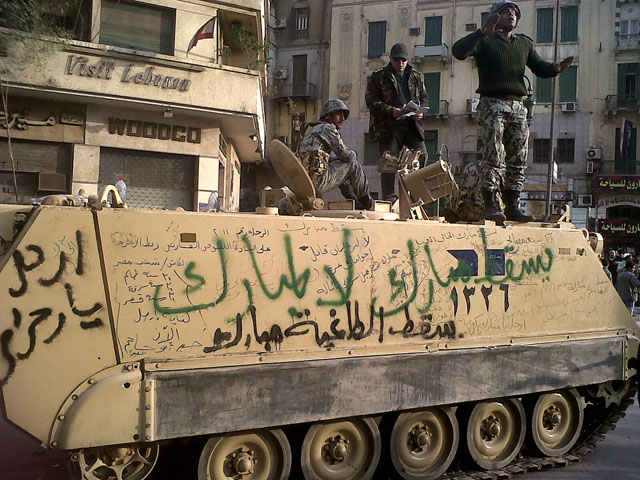
The last lesson remains the most important one, and is that the people together can defeat the might of an army when their cause is strong enough to crack the legitimacy of the regime and when they stick together against despotism. Egypt is the second biggest recipient of military aid of the USA, after Israel. The third, after Egypt, is Colombia. This has been traditionally used to state the difficulties of social change in Colombia. And difficult it is, but we should remember at all times it is not impossible. Sure, the difficulty of the struggle ahead lays on specific differences with the Egyptian situation –an ongoing civil war in the Colombian case, the development of political thuggery into the murdering machine of paramilitarism, and last but not least, that in Colombia, unlike Egypt, you have a formal democracy. But, let us remember, the Colombian “democracy” is ten times bloodier than the Egyptian dictatorship: the paramilitary scourge killed at least 180,000 people according to the General Attorney in less than 20 years; over the last three years of the Uribe administration, at least 40,000 people disappeared. Last year, while the world was delighted with the new “democratic and human rights-friendly” discourse of new president Santos, according to the UN massacres rose up by 40%, The mechanisms of legitimacy of the respective regimes in Colombia and Egypt are different, but other than that, there is no question of one being any more “benign” than the other, at least from the point of view of the ordinary folk and particularly, of the victims.
While most of the right wing intelligentsia of Latin America and the US are displaying their appalling lack of political understanding of what is happening in the world these days, oscillating between caution at the risks of “too much democracy” in the Arab world and hoping, without any sense of reality, that these rebellions (that happen in the Arab backyard of the US) spread to Cuba or Venezuela (!) –the social movements need to get their own lessons. And surely, the lessons of what is happening in the Arab world are more relevant to Colombia than anywhere else in Latin America. If the closest Arab ally of the US was defeated by its own people, sure there is no insurmountable obstacle for the people in Colombia to defeat the chains that keep them in poverty, fear, subjection and oppression.
THIS ARTICLE WAS TAKEN FROM THE LATEST EDITION OF OUR COLOMBIA SOLIDARITY NEWSLETTER - IF YOU WANT TO BE ADDED TO OUR MAILING LIST FOR THE NEWSLETTER, JUST EMAIL US AT raices2007@gmail.com
|








 printable version


 Digg this
 del.icio.us
 Furl
Furl Reddit
 Technorati
 Facebook
 Gab
Gab Twitter